Wednesday, May 9, 2012

Agra


After we checked into our hotel in Agra, we met our driver and guide and they took us to a restaurant for lunch.

After lunch we headed over to the Agra Red Fort.  After getting past all the vendors, beggars, and would be tour guides, we made it inside the fort.  We paid a few dollars for an audio tour guide-it was worth it.  


When we finished with the tour, we rejoined our driver and guide.  They started to take us to a shopping area-we had to absolutely insist they turn around and take us to the Baby Taj, which the schedule we had previously agreed upon.  The fact that they tried to just slyly skip that stop was irritating…(something to be aware of if you ever travel to India.)


The Baby Taj is the tomb of Mumtaz Mahal’s grandfather.  Mumtaz Mahal is the queen buried in the Taj Mahal.  The Baby Taj was lovely.  We happened to be there right at sunset.  It was gorgeous. 


We finally agreed to let our driver take us to the “shopping bazaar” as they were calling it.  According to the sign out front, it was a certified Government approved handmade wares shop.  But who knows for sure. 

The first thing we were shown were the handmade rugs.   Fortunately, we really liked the man who was showing us the rugs.  He made the experience quite enjoyable.  And even though we probably paid far too much for it, we got our few souvenirs of the trip-an area rug and two gorgeous wall hangings. 

(We bought the one on the upper right.)
The day ended back at our hotel restaurant.  We had a lovely, quiet meal together before preparing to see the Taj Mahal the following morning. 


Pin It!

hellohellohello


“hellohellohellohello! Where you want to go? I take you there! Taxitaxitaxi? Hotelhotelhotel? Hello???!Hellohellohello! I know someone, I take you somewhere!”

The international airport in New Delhi is deceptively nice.  Clean, well kept.  No one asking for tips.  People leave you alone.  Once you walk out the baggage claims doors, all bets are off. 

People instantly surround you, shouting about hotels and taxis.  The cacophony of voices, traffic and car horns is practically deafening.  Fortunately, I had done extensive research and knew to go to the police run pre-paid taxi booth.  We were able to make it to our hotel without a hitch and didn’t  ripped off-the constant challenge of traveling alone in India. 

The next morning we would catch a train down to Agra-about a three hour train ride from New Delhi. 

We left from N. Hizamuddin station.  For someone used to the incredible infrastructure and service of the trains in Japan, this was a far cry from what we were used to.  The security was practically non-existent.  Virtually anyone was able to wander in and get on a train.  Not a single person checked our tickets. 

We found our train and our seats with little trouble.  The long, cold, depressing ride to Agra began. 

Traveling by train in through India is an experience.  The trains themselves are very old and absolutely filthy.  While it had been warm and lovely weather in Andrah Pradesh, north India was cold.  And the windows of the train wouldn’t stay closed.  


Riding through New Delhi and seeing the slums was difficult.  The sheer volume of trash and filth polluting the land and rivers of the city was nothing short of disturbing.  Poor people were rooting through the piles of garbage, looks for anything to salvage.  


Because of the lack of security at the train stations, anyone could board the train.  This meant that people were constantly walking up and down the train either trying to sell us things or begging.  Shoving English notes in our hands explaining their destitute situations. 

We had been warned by our Indian friends at ARV to not give to any beggars because there are so many “professional” beggars who prey on foreigners.  Also, because we had already given so much through our work in Chevuru, Karl and I decided to not give anything to any beggars. 

The only way to deal with beggars and people trying to sell you things was to completely ignore them.  Never ever make eye contact.  I hated this.  The hardest thing for me about traveling in India was being forced to be mean to avoid being taken advantage of.  It was absolutely impossible to trust anyone.  You had to barter over prices for everything. 
It was completely exhausting. 

Just outside of Agra train station, we hired a driver and tour guide to take us to our hotel.  We also chose to engage them for the rest of our time in Agra.  Them seemed nice enough. 

When you hire a driver or tour guide in India there is an extremely good chance that they are associated with certain shops.  The shops pay the drivers and guides a commission for bringing tourists in to buy things. 

Our driver and guide told us that they knew our hotel and the man who ran it-and not to trust him.  The man who ran the hotel told us the same thing about our driver and guide.  Who to believe?  The feeling of being constantly lied to and deceived was horrible. 

But this is the way traveling in India works.  You can never let your guard down. 


Pin It!

Leaving Andrah Pradesh


A custard apple growing outside of ARV's office building.
 The next morning Heather and Denise caught a train back to Chennai.  Karl and I were taken shopping and to lunch before our flight left.


We would fly back up to New Delhi to spend our last few days in India sight seeing on our own. 

It was sad leaving Ravi and the ARV team.  We had learned so much from them.  They had taken good care of us, leaving nothing for us to worry about. 

Our time alone in India would be completely different…
Pin It!

peeking in from outside


On the second day of January, we were went to two places.  The first place was a little school.  ARV gives the funds to this school to pay the salaries of the teachers.  The students who attend the school are mostly Dalit children who would not otherwise be able to attend any school at all.

We were welcomed and invited to teach special English lessons.  Karl and I team taught the little preschoolers while Denise and Heather split the older children into two classes. 


After our impromptu lessons, there was more cake and speeches.  (It happened to be Ravi’s birthday-this was the first of three cakes.)


For lunch we were able to drive to one of Ravi’s brother’s homes for lunch.  This brother is a protestant minister and lives right next to his parish with his lovely family.  (Ravi also has a brother who is a Catholic priest.)

The second place we visited that day was another Dalit village.  We were going there to speak in particular to the young adults of the village.  One of the biggest struggles for Dalit children growing up into young adults is the significant lack of self confidence.  We spoke to them, trying to encourage them to continue working towards their goals. 

It felt strange…they told us that just the fact that we came to visit them meant the world to them.  And here I felt like I could do nothing for them.  Being in India was a real lesson in perspective for me-you simply cannot gauge or judge other peoples experiences for yourself.  It is wholly unfair to them. 

It is possible to do something for someone that seems perfectly trivial from your perspective, but for them could mean the difference of life or death.  You can never truly know how important your actions might be for someone. 

Coming to India to work with the Dalit people as an American who is living Japan was an awakening.  I struggled with feeling guilt simply because of where I came from and the opportunities I have been given in life.  I wanted so much to do more for the people we met…but what?  Trivial gifts like pens and candy do nothing for the long run and real changes.  I honestly felt helpless.

Over the past few months since the trip, I have reflected and thought of ways to help.  How can we possibly make real significant changes to help these people?  This is difficult because once you leave a place like Chevuru and return to your own life, it is astonishingly easy to slide back into your routine and forget what you saw and experienced. 

We are voices.  We took time, resources, and money and gave them to help the Dalit people.  We did make a difference.  I feel that the most important thing for us as volunteer alumnae is to not forget and continue to be voices for the people we helped.


Pin It!

The New Year


Most of the Dalit people have rejected the Hindu religion and the caste system.  Ravi explained to us that the vast majority of Dalits are Christian.  There are two Christian churches in Chevuru-one Catholic and one Protestant.  We never were able to meet the priest who served at the Catholic church, but the Protestant minister lived right in town.
On Sunday January 1st 2012, we dressed up in our new sarees and went to church with the people of the village.  At the end of the service we were thanked for our efforts with the gifts of flowers, cake, and smiles. 


They asked us to sing.  The only thing I could think of at that moment was Amazing Grace.  We sang for them as a final gift.  

The week we spent with the Dalit people of Chevuru was a week I will never forget.  Trying to process everything I experienced there has been a continuous effort.  For the first two months after returning to Japan, I could hardly look at the photos-I was emotionally overwhelmed. 

I think the reason it was and is hard for me to reflect on this trip was because I felt like I needed to do more for these people.  The world suddenly felt so unjust.  I saw these little children who had been arbitrarily born into absolute poverty.  Not that these people don’t have a chance at creating good lives for themselves.  They do.  But the barriers they face in this world to create secure futures for themselves are unspeakably higher then anything I have ever imagined. 

Experiencing the people of Chevuru provided for me the chance to intensely reflect on my own life.  A few things I continuously work on are:

-Be positive.  Laugh and smile every day.  You always have a choice in how you react.

-Simplicity is beauty.

-Take nothing for granted.

-Work hard.

-Be thankful.

-Have faith.

-Help each other. 

-Take time for joy.
-Always accept gifts. (Even if you have already eaten seven bananas.) Expressing hospitality is a human right.

-Putting on a saree is a long process not easily accomplished by oneself.

-Accept peoples gratitude-even if it is difficult or you don’t agree.  Everyone’s own feelings belong to themselves-not you or anybody else.

One of the people we met wrote a poem for us. Ravi read and translated it for us.
Pin It!

Monday, May 7, 2012

Back to Work


Well, everyone else was back to work but me. 

Despite having gone to the doctor before leaving for India as well as taken copious amounts of medicine for two weeks solid, I still had not shaken my cold.  Therefore it was decided by Ravi that my only task for the day would be napping.  I was exhausted from all of the traveling, jet lag, and all that comes with being immersed in a foreign culture.

So slept I did.  For about four hours. 

While I was busy sleeping/recovering, the others were busy working on the third and final roof of the trip.  I felt bad for not being able to help but relieved at the same time.  Roofing homes using cement is extremely hard work.  This would be the last day of work in the village for our group.  

Karl with our friend Chendu.
Hard workers after roofing a home.
They had enough supplies to continue work for another few days after we left.  After that, the unfinished homes would again come to a stand still.  The people of Chevuru must wait until the next group of volunteers to fund raise and send the funds so that they may purchase the building supplies. 

After the hard work was finished, we were again surrounded by the young people of the village.  Three lovely young ladies, who had helped prepare our lunches every day, brought out some tubes of henna and decorated our hands and arms for the new year.
Dear Usha! She was so much fun.  She helped make our lunch every day.
Usha drawing henna on my hand.

Tomorrow we would dress in our new sarees and celebrate the coming of a new year.
Pin It!

Touring Vijayawada


I like changes.  Even if it is just rearranging furniture.  For me, change is refreshing.  Of course some changes are much easier to adapt to and deal with than others. 

Even though we had only spent a few days working in the village, the day of rest was a pleasant and unexpected change.  Not that we didn’t want to go work in the village and see the children.  Not at all.  We would have.  But when it was decided that we would instead take a day off and go sight seeing, none of us took much convincing. 

The morning of our touring day, we drove to Vijayawada to rearrange vehicles and get some snacks at Paul and Uma’s home.  Paul was our very gracious tour guide for the day while Ravi did some work at ARV’s main offices.  

Our little group with the nice lady who cooked for us.
"Follow me or you will suffer!" -Ravi regarding this spicy sauce.
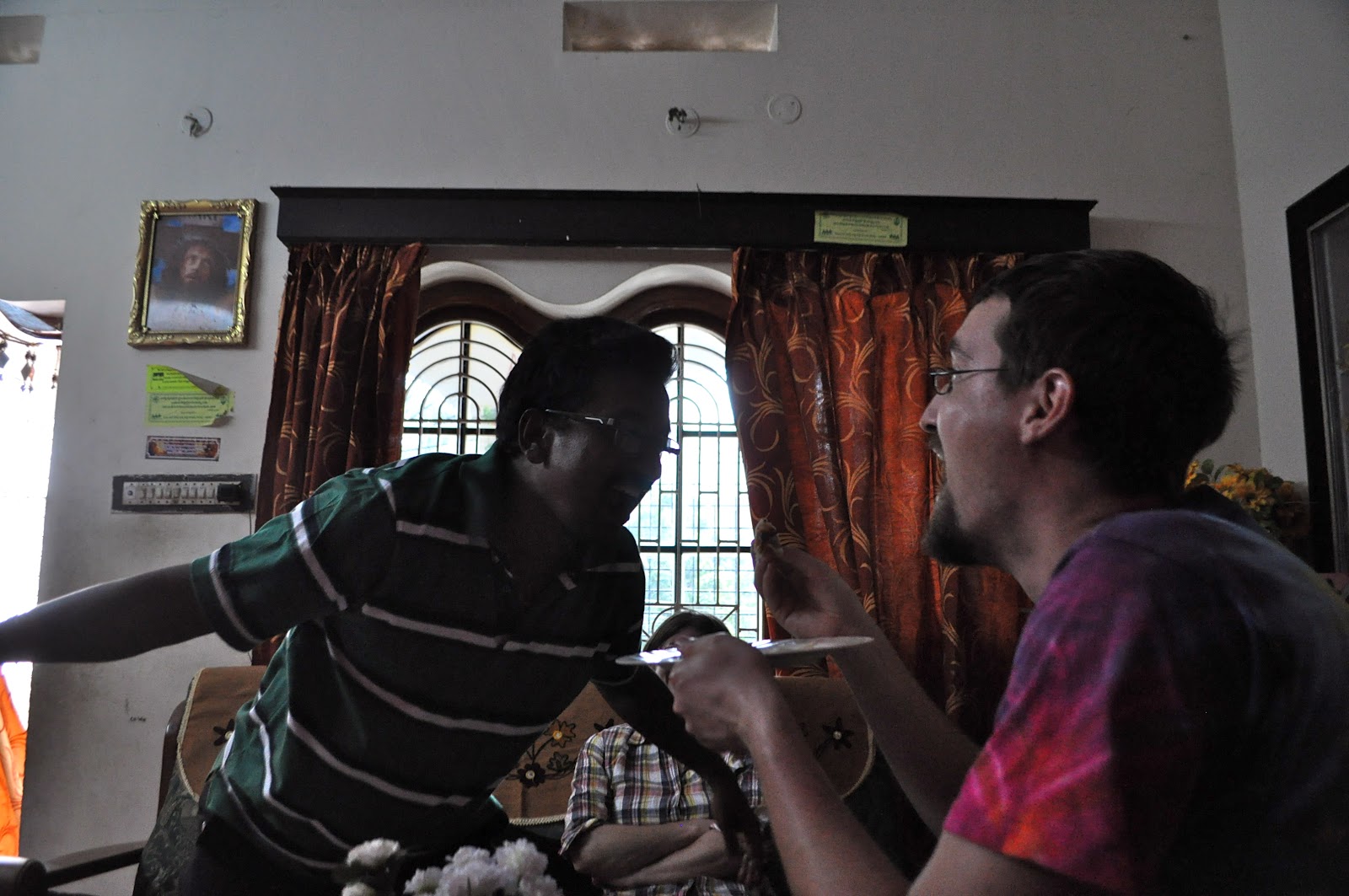
Karl feeding Ravi.

Driving through the city and then the Indian countryside was fascinating.  So much to see and take in. 

Workers harvesting marigolds for making garlands.
Doing laundry in the river.
Road side lemon shopping.
 The first place we stopped at was a giant Buddha, in the process of being built.  The year before the Dahli Llama had visited the site and given a blessing. 

Three ladies who wanted their photo to be taken.
 The second stop was an ancient Hindu temple that had been craved right into the side of a mountain.  It was fascinating.  

Meditating Karl.

As we walked along a path to see another area connected to the temple, we found ourselves being accompanied by far too many monkeys for comfort.  Two things I learned in my first encounter with monkeys: 1) Monkeys are extremely territorial.  2) Monkeys chase and hiss at you.  

After the monkeys chased us down from the side of the hill, they surrounded the restroom...unfortunately Karl was inside at the time.  He made it out ok.
There was  fair amount of rock throwing, yelling, and thrashing of sticks until we were safely away from the monkeys and back in the car.  

We ended the day by doing some shopping before heading back to our hotel in Gudivada.  The following day would be the last working day in Chevuru. 


Pin It!