Showing posts with label Kyoto. Show all posts

Thursday, October 25, 2012

Fushimi Inari Jinja


Sometimes I ashamedly reflect back onto what little I knew of Japan before moving here two years ago.  At that time my knowledge of Japan was something like this:

Sushi-Raw fish.  Totally un-appealing. (Now I love it.)

Geisha-Cans of pineapple…?  Fancy ladies with white faces?  (Just read this book-fantastic.)

Sumo-Really, really fat wrestlers. (Recently went to the Tokyo tournament-amazing!)

Ninjas-Stealthy dudes all dressed in black. (Still don't know much about them...)

Godzilla-Huge green lizard that terrorizes Tokyo. 

Anime-Really strange cartoons. (I LOVE studio Ghibli films!)

And so on. 

Fortunately, I have now learned a tremendous amount about Japan.  (In fact, I strongly believe now that living abroad is one of the best things one can do.  There are few experiences in life that are as challenging and rewarding.)

Some of the only images in my mind of Japan and its culture came from the movies.  Most recently, The Memoirs of a Geisha. 

During our time studying at Yamasa this past August, we took a few trips to Kyoto during the weekend.  One of the most iconic images of Japan-that I knew of because of The Memoirs of a Geisha-is located at the Fushimi Inari Jinja (a “Jinja” is a Japanese Shinto Shrine).  


The iconic image associated with this film happens when the main character (as a child) runs through the forest of torii to the reach the shrine where she makes an offering and prays.  This now famous scene was shot on location in Kyoto at the Fushimi Inari Jinja. 


I had been hoping to visit this shrine for some time and was delighted when the trip was scheduled.   

Lantern and gateway at the entrance of the shrine.
The main shrine building
The Shinto Inari god (Kami in Japanese) is the deity of good fortune and rice.  At every shrine dedicated to the Inari god, you will find images of foxes.  The fox-the messenger of this god-plays a significant role in the stories surrounding the Inari god. 

A fox at the entrance of the shrine.
Wooden foxes people can purchase, draw on a face, write a petition and leave at the shrine.
It is believed by those who practice Shintoism that making offerings to the Inari shrines is important to their success in business.  The number of torii at Fushimi Inari Jinja is directly related to this.  The large torii are purchased-usually by companies-as an offering and petition for continuous good fortune.  The big torii are extremely expensive. 

A map of the whole complex.
A sign depicting the prices of the torii.  The most expensive one, with the current exchange rate, is over $16,000.00 USD.

Regular folk can buy their own (much smaller) torii for their petitions.  


Unfortunately, we did not have time to make the entire walk through the torii forest.  This turned out to be a good thing… As we were walking back through the torii, thunder began to rumble in the distance.  Just as we reached the parking lot, it began to pour.

The thunder rolling in...

Visiting Fushimi Inari Jinja was one of the highlights of my summer.  If you ever visit Kyoto, it should be on the top of your list. 

Pin It!

Tuesday, October 9, 2012

Amanohashidate


I am one of those people who really likes lists.  Grocery lists, to-do lists, books to read lists, etc. Currently, the one list I think about a lot right now is my “Things To Do Before Leaving Japan” list. 

We will be in Japan for a while longer yet, but I am also a planner.  I constantly find myself thinking about the future and planning. 

During our time studying at Yamasa in Okazaki we were able to cross off some big things from the list: climbing Mount Fuji, exploring Kyoto more thoroughly (more on that later), and seeing Amanohashidate.

There are three places in Japan considered to be the most picturesque in the entire country.  The torii of Itsukushima Shrine, Matsushima, and Amanohashidate.  Two down, one to go!

Amanohashidate is a natural sand bar along the sea of Japan on the north side of Kyoto. Its natural shape is absolutely fascinating. 


We rode up a lift to reach the best viewing point.  It was stunning.  Supposedly, if you turn upside down and look at it through your legs, the sandbar will look like "A bridge to the heavens."  


Chion-Ji Temple entrance.  This temple is very close to one of the ends of the sand bar.
Bad fortunes are left at the temple.  If you get a good fortune, you take it with you.

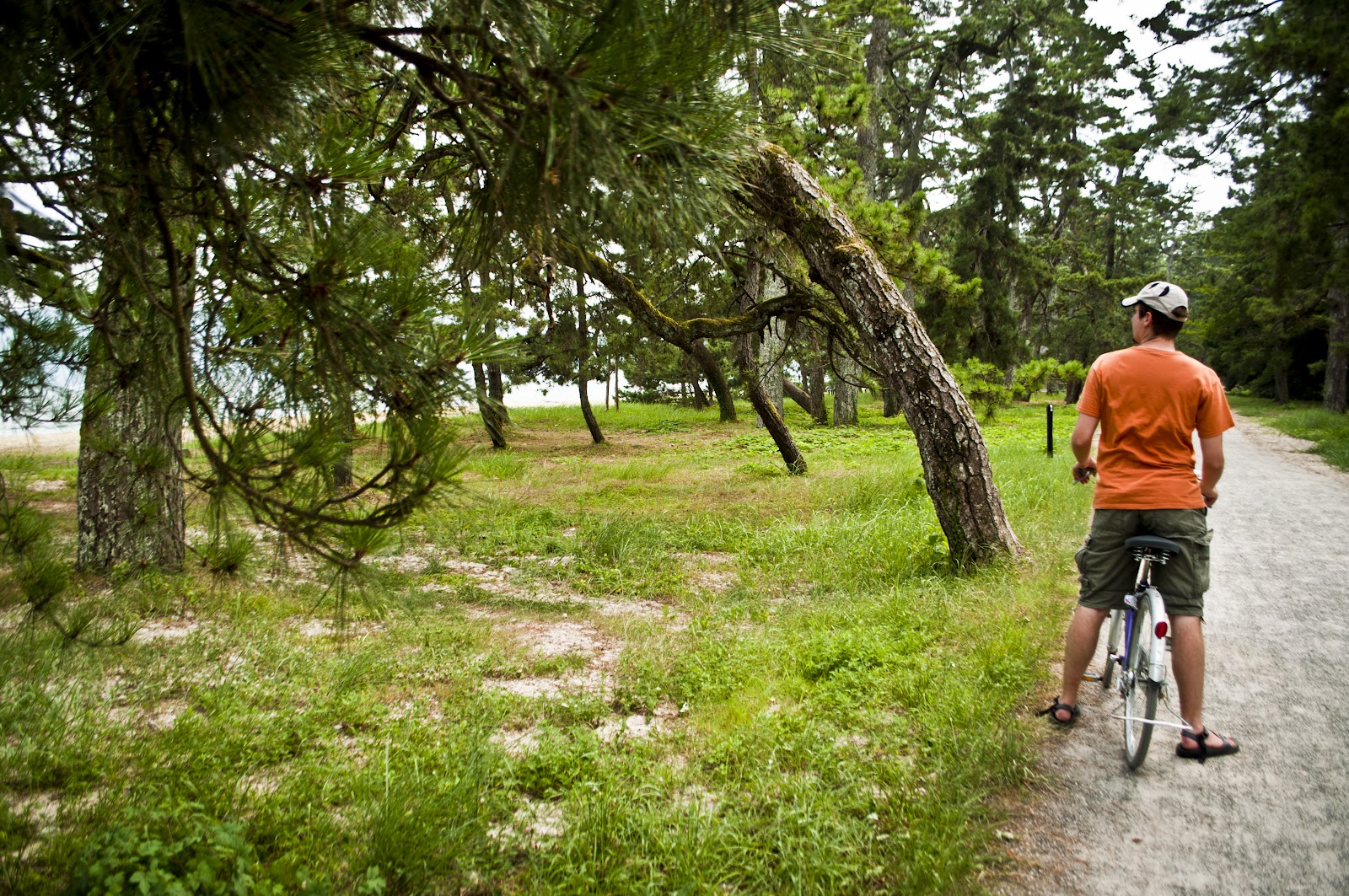
After coming back down the lift, we rented some bicycles and explored the area.  It was lovely.  I wish we had had time to take a swim.  The water looked amazing. 

Motoise Kono Shrine on the opposite end of the sandbar as the Chion-Ji Temple.
Biking across Amanohashidate
Though difficult to access by public transportation, I highly recommend seeing Amanohashidate.  With its natural shape and beauty, it’s no wonder that it on the most beautiful places in Japan list!

Do you have any suggestions for my "do before leaving Japan" list?  Leave me a note if you do! 
Pin It!

Friday, October 5, 2012

Higashi Hongan Ji 東本願寺


Across the street from our Ryokan in Kyoto, there stood an impressive looking temple-Higashi Hongan Ji Temple.  Not having much time to explore Kyoto, we decided to get up early the following morning to go have a look before heading off to our next big destination.


The streets of Kyoto were still at six in the morning.  We walked over, slipped off our shoes and walked up the steep wooden stairs to peek inside the temple.  Beautiful chanting was drifting through the open doors.  A service was taking place.  The temple members and the Buddhist monks steady chants were lovely. 
 

It is especially at times such as this that wish I knew more about Buddhism.  We have learned a bit about religion in Japan, but I still feel like I know next to nothing.  I do know that the two prominent religions in Japan are Buddhism and Shintoism.  Most religious Japanese people practice both religions.

I have heard that Shintoism is the religion of life.  All celebrations including life-new life, marriages, etc.-are celebrated in the Shinto tradition.  In fact, there are no funerals held at Shinto Shrines.  Buddhism takes care of life after death.  Funerals are held at Buddhist Temples.  The cremated bodies are placed in the burial grounds that can be found at every Buddhist Temple.

If you have any good recommendations of books on this subject, please leave me a note!  
Pin It!

Thursday, October 4, 2012

Hello, Dolly (A night of Jazz)


…a jazz bar.  A whiskey jazz bar, to be exact.  This place was about as un-Japanese (traditionally speaking) as you can get.  The name of the bar was Hello, Dolly (Sorry, couldn't find a good English website.)

  
(Be warned: The audio for this video is not good, though it nicely shows the inside of the bar.)

Unfortunately, I missed the fine print on the sign outside and didn’t realize that there was pretty hefty seating charge.  Whoops.  Despite that, we had a great time.  Had a fancy drink, enjoyed the atmosphere, and listened to the fantastic jazz quartet. 


It was great. If you are looking for a great relaxing finish to a day in Kyoto, I highly recommend this bar!
Pin It!

Wednesday, October 3, 2012

Weekend Trips: Mikatagoko, Obama (the town)


One of the great things about studying at Yamasa for us was the proximity to new places.  We live very close to Tokyo-which is wonderful-but we love traveling and exploring other parts of Japan. 

Yamasa offers fantastic weekend trip opportunities.  We took advantage of one over night trip and two day trips during our time there.  Unfortunately for us, the first trip-the overnight one-included lots of traffic which resulted in cutting about half the original itinerary.  (One of the later days trips made up for what we missed.)

The first place we visited on our overnight trip was a National Park in Fukui Ken called Wakasa Bay Quasi.  According to the sign, these are “Wetlands of International Importance” and serve as breeding grounds for several types of invaluable fish. 

Map of the Mikatagoko area.
One of the attractions is at the top of one of the mountains.  We rode a lift to the top where we had an fantastic view and saw some interesting attractions:

The lift.
You could buy a lock, etch a message on it (usually a romantic one), and then lock it on the railing. 
There were virtually thousands of locks on the railings!
Little clay discs you could buy, write a messgae on and hurl over the railing into the forest.
Karl throwing his wish.
Kabuto Mushi-all of my elementary students are obsessed with these beetles.
Kabuto mushi eating a sugar jelly.
Map and view from the top.
Our second stop for the day was a brief drive through the little coastal town of Obama in Fukui Ken.  When President Obama was elected in the United States four years ago, this little town suddenly experienced world-wide fame. 


Our day ended back in Kyoto.  We had a full kaiseki meal at a restaurant in the Gion district.  During the summer the restaurants along the Shirakawa River set up special decks that float above the river.  This provides a cool relief from the oppressive humidity of the Kyoto summer. 


The dinner was delicious.

Pin It!

Wednesday, May 16, 2012

Leaving Kyoto


You know the type of place you visit for the first time and are just amazed?  When it comes time to leave you are already making plans to return?  I have lots of places like that.  And Kyoto is one of them. 

On the morning of the day we had to leave Kyoto, we had just enough time to go see one of the most famous temples in Japan-and probably the world.  The Temple of the Golden Paviliion-Kinkakuji (金閣寺)in Japanese.   


We got there by bus from Kyoto station-which I do not recommend.  It was hot, extremely crowded, and took more than an hour.  But any suffering we put up with on the bus was made up for when we got to the temple.


It was beautiful.  Picturesque in a way that almost didn't seem real.  The weather was perfect-the brilliant blue sky reflected in the calm pool that surrounds the temple.   It was breathtaking. 

When the time came to leave, we took a taxi.  Totally worth it.  We had to make to the train station to catch our shinkansen (bullet train) to our next destination. 

We finally reached Kawaguchiko station around 6 that evening, after the train ride and a long bus ride. 

Kawaguchiko Station lies right at the foot of Mount Fuji.  The next day, we would take a day long bus tour around the mountain and the five lakes of Mount Fuji-the “Fuji go ko.”  We were staying at another branch of K’sHouse-it was fabulous.  Excellent service and rooms. 

Exhausted from all of our travel, we managed to rally and go out in search of dinner.  The fates smiled on us: right around the corner, we found an Indian restaurant.  It was perfect.  (I looooove Indian food. Love it.)

Drinking Indian beer-the same kind we drank in India a few months ago.

Pin It!